
Fortnite Cheats Compared: A Single Product Against a Marketplace
Marketplaces sell choice. Single products sell consistency. This compares both models on feature depth, update handling and support, without pretending one is right for everyone.
There are two ways to buy Fortnite cheats and they are structurally different. One is a catalogue of third party builds, each from a different developer. The other is a single first party product you buy once and learn properly.
ForgeCheats is the clearest example of the first model. It lists 16 Fortnite cheats from separate developers, sold on daily, weekly and monthly terms, with status labels and a comparison table. Ours is the second: one product, two durations, one feature set, delivered through Cloud DMA.
Neither model is a scam. They just fail in different places, and which one suits you depends on whether you want options or want to stop shopping.
Billing model
ForgeCheats sells at the cheapest end of the market on daily keys, with weekly and monthly plans sitting on the individual cheat pages. The daily entry point is genuinely low and it is the fastest way to test whether cheating in Fortnite is for you at all.
The trade is that a daily key is roughly two and a half times a monthly sub per day. Daily keys are for sampling, not for a season.
Ours is monthly or lifetime, with no daily tier. That is a real disadvantage if you want one evening to decide, and an advantage if you already know you are staying.
Feature depth
Marketplace listings are as deep as the individual developer made them, and they vary hard. Some carry ESP, radar and aimbot with real configuration. Others are closer to a box and a snap line. Reading the tags matters, because the cheapest listing and the most expensive one are not the same class of software.
The Fortnite cheat here ships one feature set on both durations:
- Box and skeleton ESP with separate visible, hidden, knocked and team colours
- Radar with render radius, distance scaling and orientation lock
- Item ESP filtered by rarity with amount and distance readouts
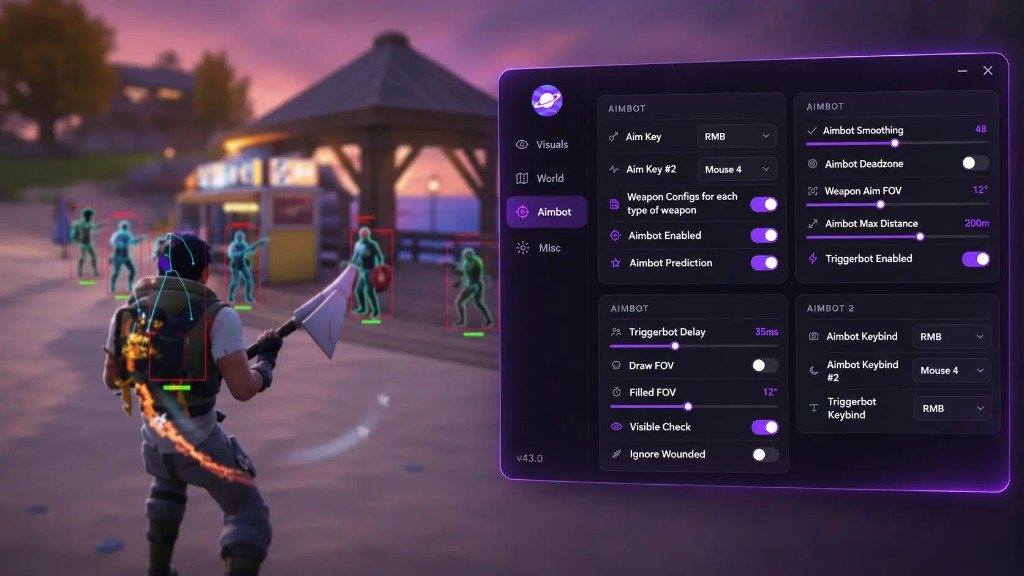
- Aimbot with per weapon configs, prediction, four hitboxes, smoothing, deadzone and FOV
- Triggerbot with its own delay and keybind
- Stream proof mode for OBS and Streamlabs
- Saved configs and a battlemode toggle
Nothing is withheld behind a higher tier. The features you read on the page are the features you get on the shorter licence.
Choosing between 16 things
Sixteen options sounds strictly better than one. In practice it moves the work to you: you have to read sixteen feature lists, work out which tags actually matter for how you play, and guess at quality because the tags describe features, not reliability.
A single product removes that. You learn one menu, build two configs, and stop thinking about the market. The cost is that if the feature mix does not match your playstyle, there is no cheaper sibling to fall back on.
Updates after a patch
Fortnite is a moving target. It loads Easy Anti-Cheat, and Epic also runs BattlEye in some configurations, so the update cycle is tighter than most games. Every provider deals with this, and how they deal with it is worth checking before you pay.
A marketplace can absorb a broken build by flagging it and pointing you at the others. The upside is you are rarely fully locked out. The downside is that the build you actually learned and configured can go offline with no notice, and the replacement has a different menu, different defaults and different behaviour.
A single product goes down with the game instead. When a patch breaks it, it breaks for everyone and the fix is one build rather than a triage queue. Subscribers get compatibility updates at no extra cost, and support is answering questions about the same binary everyone else is running.
Support
Marketplace support is usually per developer, over Telegram. That can be fast and specific when the developer is active. It can also mean chasing a seller who is asleep, for a build that is not theirs to fix at platform level.
Ours runs on tickets and Discord, with order ID and setup help. It is one queue for one product, which is slower to start and steadier once it is moving.
Infrastructure
This is the biggest practical difference and the one least visible before checkout.
Every listing on a marketplace assumes you bring your own delivery method. The DMA section on ForgeCheats states plainly that a DMA card is required. Buy a card, install it, then buy a cheat.
Our stack is Cloud DMA instead: a Hyper-V environment on the same PC, no card, no second tower. It is a one time purchase, and it needs GREENWARD, a Static Server and AWS as separate purchases. That is more setup paperwork than a marketplace and less hardware shopping, but it is mandatory, not optional.
Where each model wins
Choose a marketplace if:
- You want to spend one evening testing before deciding
- You like comparing builds and do not mind re-learning menus
- You already own a DMA card and the ecosystem around it
- You want the lowest possible entry point for a single session
Choose a single product if:
- You want one menu to learn and two configs to save
- You play most days and a monthly or lifetime licence beats daily keys
- You would rather not shop again after this
- You want the same feature set on the shortest licence as the longest
The thing both models share
No provider can promise permanent undetected status. Ban waves happen on Epic's schedule, not a seller's. What you can compare is update speed, whether statuses are corrected live, and whether support answers a real question about a real build.
Judge both on that, not on the word undetected in a headline. If you want the deeper picture, what undetected actually means in Fortnite covers it without the marketing.
If the single product model fits, the Fortnite cheat page lists the full feature set and both durations, and the pricing breakdown covers how the billing models work and what sits outside the licence.